
2026-04-18
Laparoscopy vs Open Surgery: Recovery Benefits Explained
Understand why laparoscopic surgery often leads to smaller cuts, less pain, and faster recovery, and how Dr. Qasim Khan plans safe treatment for each patient in Mumbai.
When faced with the need for abdominal surgery—whether for gallbladder stones, a hernia, or appendicitis—one of the key decisions you and your surgeon will make is the surgical approach: traditional open surgery or modern laparoscopic (keyhole) surgery.
Dr. Qasim Khan, a leading laparoscopic and minimal access specialist in Mumbai, evaluates each patient's condition individually. The priority is always patient safety, minimizing post-operative pain, and supporting a predictable recovery.
Understanding Open Surgery
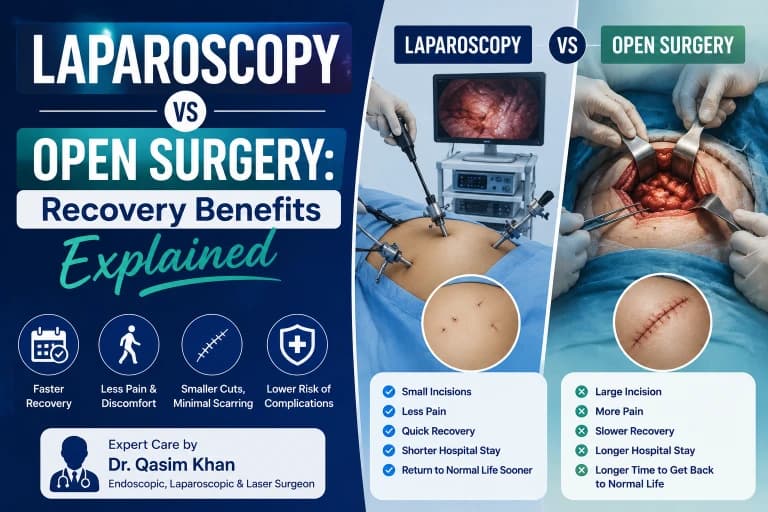
Open surgery is the traditional approach where the surgeon makes a single large incision (typically 3 to 6 inches or more depending on the procedure) to directly view and access the abdominal cavity. While open surgery has been the standard for decades and remains essential for certain complex or emergency conditions, the larger cut leads to increased muscle trauma, longer healing times, and higher post-operative pain.
Understanding Laparoscopic (Keyhole) Surgery
Laparoscopic surgery is a minimally invasive technique performed through 3 to 4 tiny incisions, usually ranging from 5 to 10 mm in size. A laparoscope—a thin tube equipped with a high-intensity light and a high-definition camera—is inserted through one of the incisions. This transmits live, magnified video feeds onto a monitor in the operating room. The surgeon then uses specialized, long-shafted surgical instruments through the other tiny incisions to perform the procedure with high precision.
Laparoscopy vs Open Surgery: Head-to-Head Comparison
To help you understand the differences, here is a direct comparison of both surgical approaches:
- Incision Size: Laparoscopy uses tiny 5-10 mm keyholes, whereas open surgery requires a single, large 8-15 cm incision.
- Post-Operative Pain: Minimal tissue disruption in laparoscopy results in much lower pain levels compared to the significant muscle cutting of open surgery.
- Hospital Stay: Keyhole patients are typically discharged within 24 hours (often as day-care). Open surgery patients require 3 to 5 days of monitoring.
- Recovery Timeline: Laparoscopic recovery takes 1 to 2 weeks for a full return to work, compared to 6 to 8 weeks for open surgery.
- Complication Risk: Smaller wounds drastically reduce the risk of wound infections, bleeding, and incisional hernias.
Key Recovery Benefits of Laparoscopic Surgery
Minimally invasive keyhole procedures offer distinct advantages that directly support patient comfort and healing:
- Reduced Wound Care: Tiny keyhole incisions require minimal dressing changes and leave small, cosmetic scars that fade over time.
- Earlier Mobilization: Less abdominal wall trauma allows patients to stand and walk within hours of surgery, reducing the risk of deep vein thrombosis (DVT) and lung congestion.
- Less Scar Tissue (Adhesions): Minimizing internal organ exposure lowers the formation of post-operative internal scar tissue.
When is Open Surgery Still Necessary?
Laparoscopy is highly versatile, but patient safety always comes first. Open surgery may still be recommended by Dr. Qasim Khan in cases of:
- Severe, dense internal scar tissue from multiple prior surgeries.
- Advanced, complicated infections with severe swelling that obscures the camera view.
- Emergency situations with sudden bleeding or complex, late-stage anatomical issues.
Frequently Asked Questions
Can all abdominal surgeries be done laparoscopically?
Most common abdominal procedures—such as gallbladder removal, hernia repair, and appendectomy—are performed laparoscopically. However, the final choice depends on your overall health, scan results, and prior surgical history.
Is keyhole surgery safe?
Yes, laparoscopic surgery is highly safe and has been a standard surgical method globally for decades. It is associated with fewer complications, such as wound infections and bleeding, compared to open surgery.
How soon can I exercise after laparoscopy?
Most patients can resume light walking the day after surgery. However, heavy exercise, swimming, and heavy lifting should be avoided for 4 to 6 weeks to allow the internal abdominal muscles to heal fully.
Conclusion
Laparoscopic surgery offers a highly patient-friendly alternative to traditional open procedures. By choosing keyhole access, patients experience smaller cuts, minimal pain, and a rapid recovery timeline. Consult Dr. Qasim Khan to determine the safest approach for your surgical needs.
Related Topics
Explore the key topics covered in this article.
Patient Consultation & Surgical Care Service Areas
Dr. Qasim Khan provides advanced laparoscopic, endoscopic, laser, and general surgical consulting across these regions: